

Blepharoplasty surgery – What it is
Minimally invasive blepharoplasty is the only solution for individuals with significant eyelid laxity and drooping that can even obstruct peripheral vision. It provides impressive results in the clarity of the gaze and the overall appearance of the face.
Truths about blepharoplasty
Because it is a surgical procedure, Plastic Surgeon Georgia Chorti, with extensive experience in surgical blepharoplasty, recommends it on an individualized basis only when it is the only effective solution to the problem. Generally, surgical blepharoplasty is performed after middle age. However, younger individuals with a hereditary tendency for eyelid drooping, or those whose careers rely on their appearance, may require the procedure earlier. Patients considering blepharoplasty should also know that its results last approximately 7–10 years, and therefore it is advisable to first exhaust non-surgical treatments.
Blepharoplasty does not eliminate the crow’s feet wrinkles completely, but reducing the weight of the drooping eyelid significantly softens their appearance. For these wrinkles, complementary non-surgical treatments can be applied. Blepharoplasty also does not address forehead skin sagging, which can be treated with other **non-surgical treatments** such as **Plexr**, helping to tighten the area above the blepharoplasty incision up to the brow. It can also be combined with **Thermage radiofrequency therapy**. Surgically, it can be combined with **Browlift**.
In summary:
In the hands of an experienced plastic surgeon, blepharoplasty is a routine procedure performed safely with excellent aesthetic results. The desired and feasible extent of correction must be agreed upon between the doctor and patient based on individual characteristics. Often, Dr. G. Chorti encounters previous problematic surgeries with overcorrection due to lack of experience.
How blepharoplasty surgery is performed
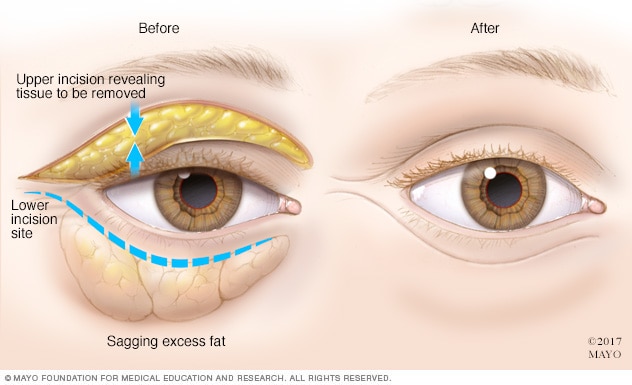
Surgical blepharoplasty removes excess skin from the upper and lower eyelids, as well as the fat accumulated under the lower eyelids (bags), in order to redistribute it properly and eliminate dark circles. The procedure can be performed on all four eyelids (full blepharoplasty) or only on the upper or lower lids (partial), and it can be combined with a forehead lift.
Blepharoplasty is performed under local anesthesia, applied separately to each of the four eyelids using a fine needle. In special cases, it can also be done with sedation or general anesthesia. Instead of a scalpel, a laser—an advanced version of the scalpel—is used, which cuts and simultaneously cauterizes. The laser is used to make the external incision.
It can also create a type of internal tightening. The stitches are very fine and absorbable.
For each eyelid, the surgical procedure lasts approximately 20 minutes. Patients typically leave the operating room after about 1.5 hours, depending on any additional combined procedures performed.
**Upper eyelid surgery** is performed along the natural crease so that after healing, the incision is not visible. A spindle-shaped section of skin is removed, and very fine sutures are used to close the eyelids. Any excess fat is also removed if present.
**Lower eyelid surgery** involves an incision 1–2 mm below the eyelashes, extending outward along the wrinkles at the outer corner of the eye. Since excess fat is more common under the lower eyelid, it is removed through very small incisions in the orbicularis muscle of the eyelid.
There is another technique suitable **only for individuals with excess fat under the eye** and no skin laxity: an internal incision on the inner side of the lower eyelid, leaving no visible scar.
If correction of the outer corner of the eye (canthus) is needed to restore its original position or change the eye shape, **canthoplasty** or **canthopexy** is performed.
Results
The results of surgical blepharoplasty are remarkable compared to other techniques, as it restores the eyelids to a more youthful state and transforms the overall appearance of the face. The expression of the eyes remains the same but looks completely refreshed, with no under-eye bags or dark circles, and without the eyelids covering the pupils.
Complications
There is a risk of complications with any medical procedure, even in the most experienced hands. However, serious complications in blepharoplasty are extremely rare. The surgeon’s extensive experience and a proper, sterile environment are crucial for a successful operation. Complications can be avoided by strictly following the detailed instructions provided by the surgeon.
Postoperative condition
After surgery, the patient experiences little to no postoperative pain, which is manageable with painkillers and anti-inflammatory medication during the first 24 hours, and possibly eye drops to prevent dry eyes.
Upon leaving the operating room, the patient will have small adhesive strips on the incisions and can immediately return home, but should not drive safely. The patient can take care of themselves but must avoid bending, lifting heavy objects, crying, gym workouts, and any sports activities, as these increase blood flow to the eye area. Contact lenses should not be used for four days.
Ice packs should be applied to the eyelid area to reduce swelling (edema) and bruising, which gradually resolve within 7–15 days depending on the individual’s skin. Using thermal or mineral water on the face is allowed from the first day.
One week after surgery, the fine incisions appear pink and nearly invisible, and within a month they are completely healed.
Avoid smoking, as it delays wound healing. Avoid makeup for 5 days and wear sunglasses when exposed to sunlight.
Two months later, full healing has been achieved.